Gutter Guards for Heavy Rain in Colorado Foothill Homes

When Gutter Helmet of Denver talks to homeowners in the foothills, one topic comes up more consistently than any other: what happens to their gutters during a summer storm. Not a drizzle. Not a steady afternoon rain. The kind of storm that rolls in over the Rockies in twenty minutes, drops an inch of rain in half an hour, and is gone before you've finished watching it from the window.
For homes in foothill communities like Evergreen, Morrison, Conifer, and Lookout Mountain, that scenario isn't a rare event. It's a Tuesday in July. And for houses with traditional open gutters, it's often the moment when a drainage system that seemed perfectly adequate reveals exactly how underprepared it really is.
This article covers what actually happens to gutters during Colorado's high-intensity summer storms, why traditional systems struggle to keep up, and how a properly engineered gutter guard system changes the outcome.
Why Colorado Mountain Storms Are Different From Normal Rainfall
Most gutter systems are designed around average rainfall data. Engineers and manufacturers look at annual precipitation rates, calculate typical flow volumes, and size gutters accordingly. That approach works reasonably well in climates where rain falls gradually and predictably.
Colorado's mountain and foothill weather doesn't work that way.
The Front Range sits at the eastern edge of the Rocky Mountains, which creates a meteorological condition called orographic lift. Warm, moisture-laden air moving in from the plains rises rapidly as it hits the mountain terrain, cools quickly, and releases that moisture in concentrated, fast-moving bursts. The result is storm events that deliver extreme rainfall intensity over very short windows, sometimes an inch or more in under thirty minutes.
This isn't just a quirk of mountain living. It's a defining characteristic of Colorado's summer weather pattern, and it creates drainage demands that most standard gutter systems were never designed to handle. Understanding how gutter guards help with Colorado's spring and summer showers starts with recognizing just how different the rainfall profile here is from the national average.
What Happens to Traditional Gutters During a High-Intensity Storm
When rainfall intensity exceeds the flow capacity of a gutter system, the water has nowhere to go except over the sides. This isn't a slow process. In a genuine Colorado mountain thunderstorm, an unprotected or partially clogged gutter can go from functioning normally to cascading overflow in a matter of minutes.
Fascia and soffit damage. Water pouring over the back edge of the gutter runs directly down the fascia board and into the soffit. Over multiple storm seasons, this creates persistent moisture exposure that leads to wood rot, paint failure, and eventually structural deterioration along the roofline.
Foundation erosion and basement intrusion. When overflow concentrates at the corners of a home and pours to the ground without any dispersal, it saturates the soil immediately adjacent to the foundation. Repeated saturation creates erosion channels, hydrostatic pressure against foundation walls, and in many homes, a direct path for water to find its way into basements or crawl spaces.
Landscape destruction. Concentrated overflow from a single gutter section can erode garden beds, wash out mulch, undercut retaining walls, and kill plantings that took years to establish. In foothill properties where landscaping has to contend with rocky soil and slope, this kind of concentrated water damage is particularly difficult to repair.
Gutter separation and hanger failure. The sheer weight of water combined with the physical force of overflow can stress gutter hangers and pull sections away from the fascia, especially in older installations. Once gutters begin to sag or separate, the problem compounds with every subsequent storm.
These aren't hypothetical risks. They're the common gutter problems Denver and foothill homeowners deal with season after season, and summer storms are often the primary trigger.
The Debris Problem Makes Everything Worse
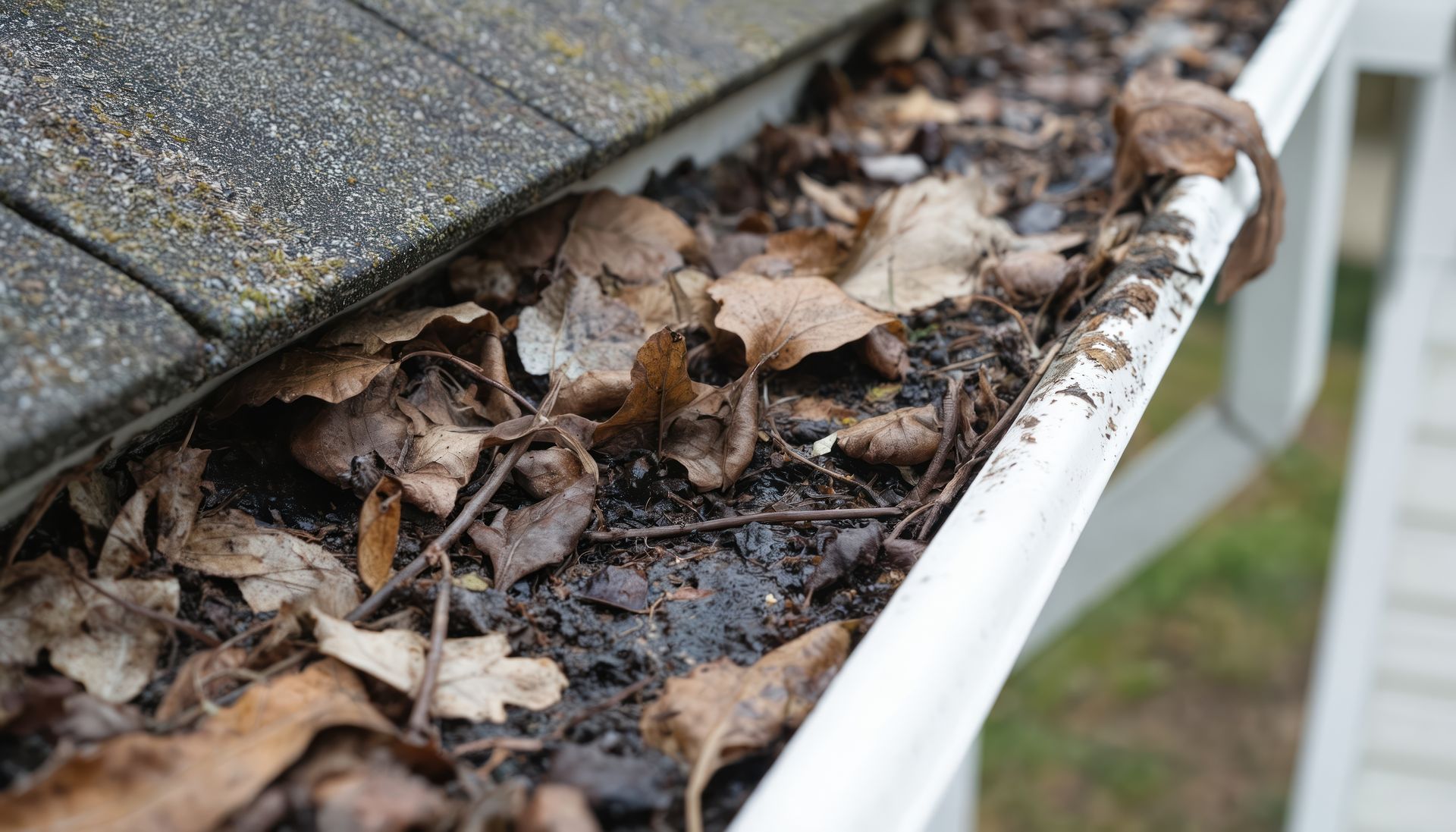
In an ideal world, a properly sized gutter would handle even a heavy Colorado storm without issue. The problem is that gutters in foothill and mountain communities rarely stay clear. Pine needles, cottonwood seeds, small twigs, and wind-driven debris accumulate throughout the summer, and even a partial obstruction dramatically reduces the effective flow capacity of a gutter system.
A gutter that's forty percent full of compacted pine needle debris doesn't flow at sixty percent capacity. The debris mats down and creates a dam effect, forcing water to back up and overflow well before the gutter's theoretical capacity is reached. By mid-summer, many unprotected foothill gutters have enough accumulated debris to fail during a moderate rain event, let alone the heavy storms that define Colorado's monsoon season.
This is the core problem that gutter guards are designed to solve. Keeping the interior of the gutter clear isn't just about avoiding cleaning chores. It's about preserving the system's ability to perform when the weather actually demands it.
How Gutter Guards Change the Equation During Heavy Rain
A well-engineered gutter guard system does two things simultaneously during a heavy storm: it keeps debris out of the gutter channel so flow capacity is maintained, and it manages the water entry point so that even high-velocity, high-volume runoff is directed into the gutter rather than overshooting it.
That second point is more important than it might initially seem. On steep-pitch foothill roofs, water doesn't trickle off the edge. It accelerates down the roofline and arrives at the gutter moving fast. A standard open gutter handles this reasonably well under light to moderate rainfall, but during a heavy storm the momentum of fast-moving water can carry it right over the outer edge of even a clean, unobstructed gutter.
A solid-surface gutter guard with a correctly engineered nose profile addresses this by using surface tension to redirect water. As runoff travels over the cover's ribbed surface and reaches the curved leading edge, surface tension pulls it around and down into the gutter opening below rather than allowing it to continue forward and overshoot. The physics of this approach, known as the Coanda effect, are what allow the system to handle heavy rainfall that would defeat standard gutter configurations.
Why Foothill Homes Face Compounded Risk
Foothill properties combine several factors that each independently increase drainage risk, and which together create a significantly more demanding environment than a typical suburban home.
Steeper roof slopes accelerate runoff velocity, as covered above. But foothill homes also tend to sit on sloped lots where water that escapes the gutter system has a natural path toward the foundation rather than away from it. A suburban home on flat ground might absorb gutter overflow into a lawn with minimal consequence. A foothill home where the grade runs toward the house can turn a gutter overflow event into a foundation problem very quickly.
Add to that the density of mature trees common in foothill communities, the distance from professional service providers, and the frequency of storm events during summer months, and it becomes clear why gutter protection is particularly important for foothill and mountain communities in a way that it simply isn't for homes in lower-elevation suburbs.
Preparing Gutters Before Storm Season Arrives
One of the most consistent findings among homeowners who experience gutter-related water damage is that the damage didn't happen because of an unusual storm. It happened during a normal Colorado summer storm, after a season of deferred gutter maintenance had allowed debris to accumulate to the point where the system couldn't perform.
Preparing gutters before storm season is the single most effective step a homeowner can take to reduce summer storm damage risk. For homeowners without gutter guards, that means cleaning before the summer storm pattern begins. For homeowners with a protected system, it means verifying that the cover surface is clear and that downspouts are unobstructed.
The goal in both cases is the same: maximum flow capacity before the first heavy storm of the season, not after.
The Long-Term Cost Argument for Gutter Protection
There's a tendency to evaluate gutter guards purely as a maintenance convenience, a way to avoid getting on a ladder twice a year. That framing undersells the financial case considerably.
The real cost comparison isn't gutter guard installation versus gutter cleaning. It's gutter guard installation versus the accumulated cost of the damage that inadequate drainage causes over a decade of Colorado storm seasons. Fascia replacement, foundation waterproofing, landscape repair, and basement remediation all carry costs that dwarf a gutter protection investment, often by a significant multiple. The ROI of gutter guards for Denver-area homes reflects this when the full picture of avoided damage costs is factored in.
For foothill homeowners who deal with heavy summer storms, pine needle accumulation, and the compounded risk factors described above, the financial argument for protection is even stronger than it is for standard suburban installations.
Frequently Asked Questions About Gutter Guards for Heavy Rain in Colorado
Can any gutter guard handle the kind of heavy rain Colorado gets in the summer?
Not all systems are equal in high-flow conditions. Fine-mesh guards and lightweight snap-in covers can fail during intense storm events, either by allowing debris buildup that restricts flow or by being physically dislodged under the force of heavy runoff. A solid-surface reverse-curve system engineered for high-flow performance handles Colorado's storm intensity more reliably than most general-market products.
How does debris in the gutter affect performance during a storm?
Even partial debris accumulation significantly reduces effective gutter capacity. Compacted pine needles create a dam effect that backs up water and causes overflow well before the gutter's theoretical maximum flow is reached. Keeping the gutter interior clear, which is what a properly installed gutter guard system does, is essential for maintaining the flow capacity the system needs during a heavy rain event.
Do gutter guards prevent water from overshooting the gutter on steep roofs?
Standard open gutters on steep-pitch roofs can experience overshoot during heavy storms because fast-moving water carries enough momentum to travel past the gutter opening entirely. A solid-surface guard with a nose-forward curved profile uses surface tension to redirect that water into the gutter rather than allowing it to overshoot. This is one of the key performance differences between a well-engineered system and a basic cover.
Are foothill homes at greater risk from summer storms than homes in Denver proper?
In most cases, yes. Foothill homes face higher storm intensity due to orographic lift, steeper lot grades that direct overflow toward foundations, heavier debris loads from surrounding trees, and greater distance from maintenance services. Each of these factors compounds the others, making gutter protection more consequential in foothill communities than in flatter, lower-elevation neighborhoods.
How soon before storm season should I have gutter guards installed?
The earlier the better. Fall is often the ideal time to install gutter protection so the system is in place before winter, but spring installation before the summer storm pattern begins is also well-timed. The goal is to avoid being in the middle of storm season with an unprotected or debris-laden system.
Will a gutter guard system eliminate the need for any gutter maintenance?
A properly installed system eliminates the need to clean the interior of the gutter, which is where the real maintenance burden lies. In heavily forested foothill environments, occasional inspection and surface clearing may still be advisable. But this is a minor periodic task compared to the full cleaning that open gutters in pine tree environments typically require multiple times per season.
Protect Your Home Before the Next Storm Rolls In
Colorado's summer storm season doesn't give much warning.
Schedule a free consultation with Gutter Helmet of Denver and get your foothill home protected before the next heavy rain puts your gutters to the test.
You might also like