Why Gutter Helmet Is a Better Fit for Colorado Rooflines
Most gutter guard marketing is written for a simple house: one roof plane, a moderate pitch, a single gutter run along the back. That house exists in plenty of places. It is not what most of the Front Range looks like.
Drive through Wash Park, Arvada, Littleton, or any foothills subdivision and you see the same pattern repeat: steep pitches built to shed snow, multiple roof planes meeting in valleys, dormers interrupting long runs, and a low-slope porch roof tacked onto a steep main roof. Those geometries change how water arrives at the gutter, and they are the reason a guard that tests well in a lab can fail badly on a real Colorado home.
At Gutter Helmet of Denver, the roofline is the first thing our estimators measure, before anyone talks about product. This guide explains what those roof shapes do to water and debris, and why a solid-surface reverse curve cover handles them differently than a screen or a mesh insert.
What makes a Colorado roofline different
Three geometry factors show up on Front Range homes more than they do nationally, and each one puts a specific kind of stress on gutter protection.
Steep pitch is the regional default
Colorado builders pitch roofs steeply on purpose. A steeper plane sheds snow instead of holding it, and it drains meltwater fast when the sun hits. The tradeoff is velocity. Water coming off an 8/12 or 10/12 pitch arrives at the gutter with real momentum rather than trickling in.
That velocity is what defeats a lot of flat-top guards. Water hits the surface, skips the opening entirely, and sheets over the front edge onto the ground below. Homeowners often read this as a clog. It usually is not. It is water moving too fast to make the turn.
Valleys concentrate everything into one point
A valley is where two roof planes meet, and it works like a funnel. Rain that fell across two large surfaces gets narrowed into a channel maybe a foot wide, then dumped into a short section of gutter. The same funnel collects leaves, needles, shingle grit, and ice.
On a home with three or four valleys, a handful of gutter feet handle a disproportionate share of the total roof drainage. Any guard that struggles under concentrated flow will show it there first, which is why valley termination points are worth inspecting before you commit to a system.
Freeze and thaw cycles run all winter
Denver rarely stays frozen. A February day can start below freezing, climb well above it by afternoon, and drop back overnight. Snow on the roof melts, runs toward the gutter, and refreezes when the temperature falls.
That cycle punishes anything porous. Mesh and micro-screen surfaces hold a film of water in their openings, and repeated freezing expands that water inside the mesh. Over several seasons, this deforms the material and opens gaps.
Where screen and mesh guards struggle on these rooflines
Screens, foam inserts, and micro-mesh products all share one design assumption: debris will sit on top and eventually blow away or break down. On a low-pitch roof in a mild climate, that assumption mostly holds.
On a steep Colorado roof it does not, for a few reasons:
- Debris arrives with force and packs into the mesh rather than resting on it
- Pine needles and cottonwood fluff are small enough to wedge into openings and hold
- Once a screen is partially blocked, fast-moving water sheets over the blockage instead of pooling and finding a clear spot
- Frozen debris fuses to the screen surface and cannot blow clear until spring
The result is a guard that still looks intact from the ground while functionally passing very little water. Our post on how Gutter Helmet works differently from other gutter guards covers the mechanical contrast in more detail.
How a reverse curve handles a steep pitch
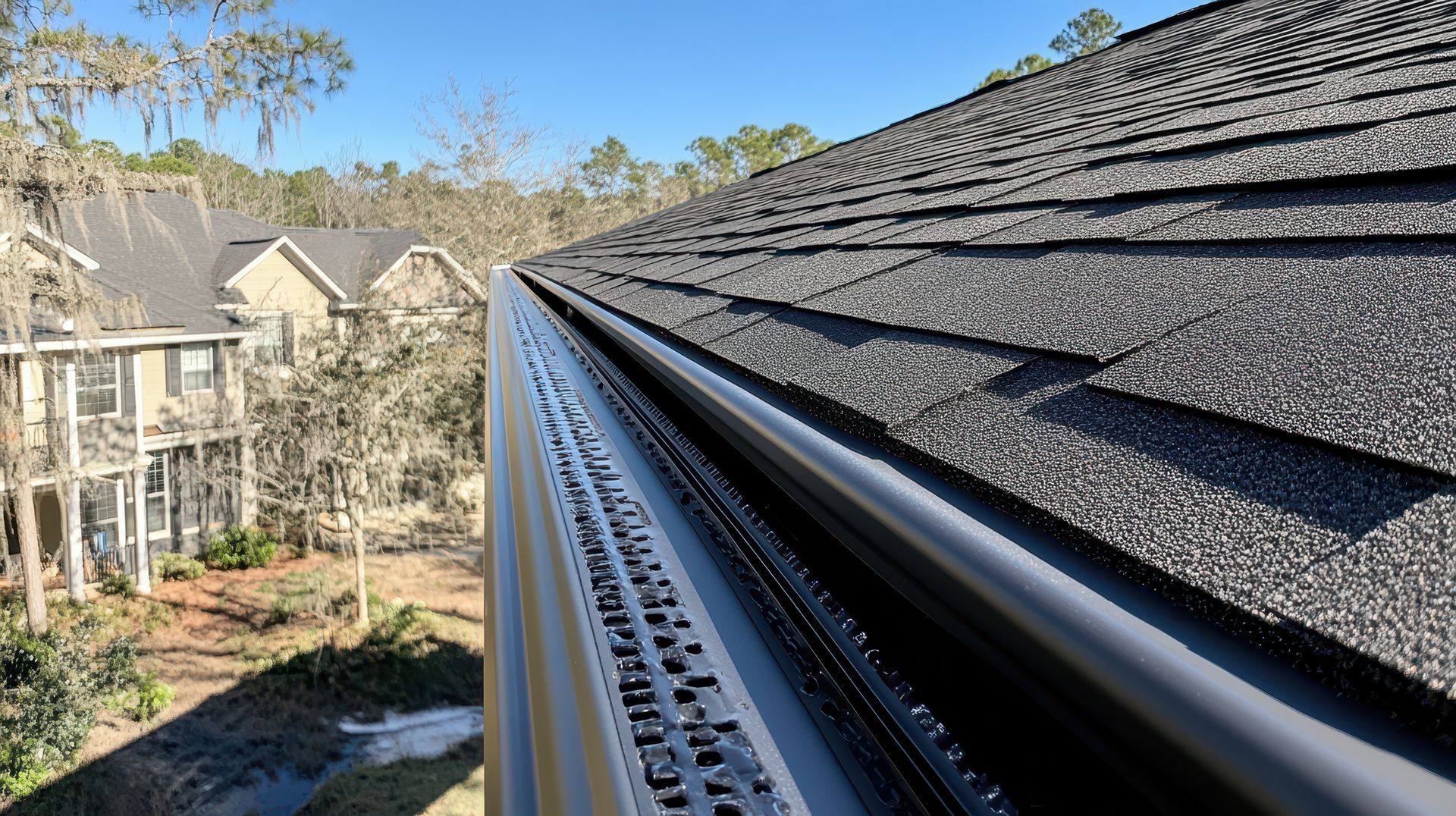
Gutter Helmet uses a solid, one-piece cover with a curved nose and a narrow slotted opening underneath. There is no screen and nothing for debris to lodge in.
Water behaves predictably on that shape. As it runs off the shingles and reaches the curve, surface tension holds it against the surface, and it follows the curve around and into the slot. Debris has no such adhesion. Leaves, needles, and grit continue in a straight line and drop off the edge.
The important part for a steep roof is that the curve gives fast water a path to follow instead of a barrier to clear. Velocity works with the design rather than against it. You can read the mechanics in plain terms in our explainer on how the gutter protection system actually works.
Roofline features that need a custom approach
A reverse curve is not a one-size product. How it performs depends on whether the installer adjusts it to the roof in front of them.
Valleys and dormers
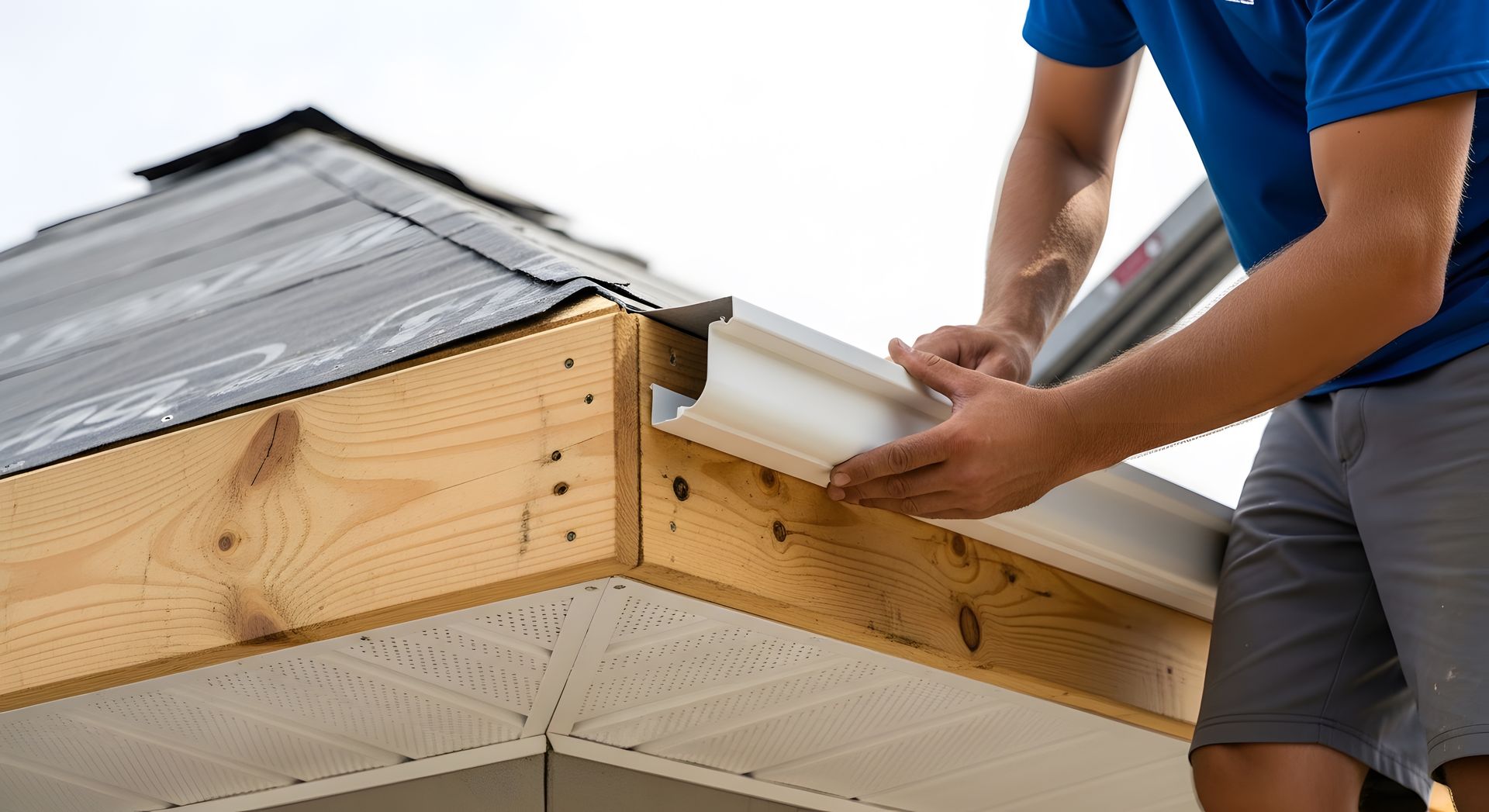
Where a valley dumps into a gutter, the opening may need to be positioned differently than it is along a straight run, and the section directly under the valley sometimes needs additional support. An installer who runs the same configuration around the entire house will usually produce overflow at exactly those points.
Long uninterrupted gable runs
A 60-foot run with one downspout at the end is a common builder shortcut. The guard is rarely the real problem here. Volume and slope are. Adding a downspout or correcting the pitch of the run often matters more than the cover itself.
Mixed pitches on one home
A steep main roof draining onto a low-slope porch roof creates two very different water speeds arriving at two different gutter sections. These sections may need different cover angles, and treating them identically is a common source of complaints about guards in general.
Homes surrounded by evergreens
Roofline geometry and debris type interact. Needles behave differently than broadleaf debris because they are small, they arrive constantly rather than seasonally, and they interlock. If your lot has ponderosa or spruce, read our notes on gutter guards and pine needles alongside this guide.
For homes at elevation, where pitch, snow, and tree cover all intensify together, our guide to gutter guards on Colorado mountain homes addresses the conditions above roughly 7,000 feet. Homes carrying serious winter weight should also review how the system handles heavy snow loads.
What to ask before you buy
Whatever product you are considering, these questions separate a measured installation from a generic one:
- How will the cover be positioned where valleys terminate?
- Does my home have enough downspouts for the roof area draining into each run?
- Is the gutter pitch correct, and will it be corrected if not?
- How does the attachment method interact with my roof edge and fascia?
- What happens on the low-slope sections, and will they be configured the same way as the steep sections?
An installer who answers these specifically is measuring your roof. One who answers generically is quoting a catalog.
Frequently asked questions
Does roof pitch affect which gutter guard I should choose?
Yes, significantly. Steeper pitches deliver water faster, which increases the chance of overshoot on flat-topped or screened guards. Solid reverse curve covers are designed to redirect fast-moving water rather than filter it.
Will a gutter guard stop water from overshooting my gutters?
A properly configured one will. Overshoot is usually caused by cover positioning, gutter pitch, or insufficient downspout capacity rather than by the guard itself, which is why these should be evaluated together.
Do I need different gutter protection on different parts of my house?
Sometimes. Homes with both steep and low-slope roof sections often benefit from different cover angles on each, and valleys frequently need attention that straight runs do not.
Can gutter guards be installed on a home with many roof planes?
Yes. Complex rooflines take longer to measure and install, but they are also where good gutter protection makes the most difference, because complex roofs concentrate water and debris at predictable failure points.
The roofline decides the outcome
Gutter protection is not really a product decision. It is a fit decision. The same cover can perform beautifully on one Denver home and disappoint on the one next door, and the variable is almost always how carefully it was matched to the roof above it.
If you want to know how your specific roofline will drain, the useful next step is having someone measure it.
Reach out to schedule a walkthrough and we will assess your pitches, valleys, and downspout capacity before recommending anything.
You might also like